Tradutor

Mostrar mensagens com a etiqueta Grécia. Mostrar todas as mensagens

domingo, março 05, 2017

Game over: The Inside Story of the Greek Crisis


George Papaconstantinou, former Finance Minister of Greece (2009-2011), presents and speaks about the topic of his new book Game Over - The inside story of the Greek crisis. The presentation explores the Greek Crisis and the broader lessons for Europe and the Eurozone
The event, organised by the Hellenic Observatory at LSE, took place on Wednesday, 22 February 2017 at the LSE’s Old Theatre. Hellenic Observatory www.lse.ac.uk

Six years since the Greek crisis erupted, Europe has been fundamentally transformed, while Greece is in its third bailout, still in severe social and economic decline. The book of former Greek Finance Minister George Papaconstantinou tells the breath-taking story of this unprecedented period, and prompts a broad discussion on the decisions taken during the crisis and on the direction of Europe  and the Eurozone today.
Why were the causes overlooked for so long by European authorities and the financial markets, and why  the consequences so severe?
Were other solutions available?
Would Greece and Europe have been better off if the country had left the Euro?
Why were the experiences of other Eurozone (Cohesion)  countries like Portugal, Ireland and Spain so different from those of Greece?
Did European, Eurozone  and global institutions, and the creditors and debtors respond appropriately?
Have the Eurozone institutions been  since reformed adequately and are there now in place safeguards to ensure an external debt crisis  cannot happen in the Eurozone  again?
These questions and the themes discussed in the book are extremely relevant today as Europe grapples with its continuing economic problems and the rise of populism.

sexta-feira, julho 17, 2015

In the Eurozone crisis, it's the trade imbalances stupid

International trade and finance theory seems to have been one of the major sacrifice of the Eurozone crisis, together with the future prosperity of the citizens in the small, peripheral net importing countries.

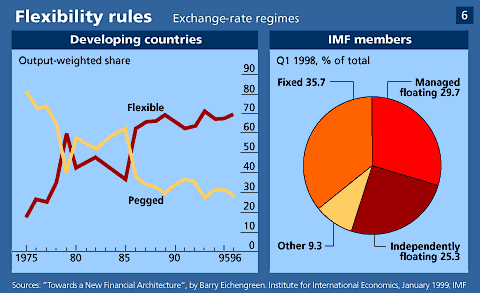
Now, a Danish economist reminds us of the principles of International Economics 201 with an article entitled, "Greece versus  Turkey:  It's the exchange rate regime, stupid".

Coming from Denmark,  the smart little country that  voted to stay out of the Euro, this deserves a good rereading by all those lawyers maskerating as finance officials. The threat of devaluation raises financing costs for an economy over the short term, a small price to pay to avoid financial disaster affecting several generations.

The persistent mantra of "exiting the bailout conditions and returning to the financial markets" which we hear from the politicians and the financial media in Portugal doesn't even begin to touch on the underlying causes and consequences of the persistent balance of payments crises.

Mariana Abrantes de Sousa 
PPP Lusofonia 
Greece versus Turkey: It’s the exchange rate exchange rate regime stupid!
A history of political dysfunctionality, corruption, military coups, military conflict with a neighboring country, large current deficits and weak fiscal management.
Greece fits that description perfectly well, but so does Turkey. So why don’t we have a major crisis in Turkey and why is Turkey not on the brink of default when neighboring Greece is?
The answer is simple – It’s the exchange rate exchange rate regime stupid!
In 2001 Turkey was forced by a major crisis to abandon it’s managed/crawling peg regime and instead introduced a floating exchange rate regime and the Turkish central bank introduced an inflation targeting regime.
14 years later Turkey is still in many ways politically dysfunctional – in fact it has gotten worse in recent years – there has been rumours of plans of military coups, there has been major corruption scandals even involving the Prime Minister (now president Erdogan) and the governing AKParty and lately the civil war in Syria has created a massive inflow of refugees and increased tensions with Turkish Kurdish population.
All this has to a large extent been reflected in the value of the Turkish lira, which have been highly volatile since 2001 – and increasingly so since 2008, but the floating exchange rate regime means that we have not seen the same kind of volatility in the domestic Turkish economy, which was so common prior to 2001.
While Turkey in 2001 floated the lira Greece gave up having a monetary policy of its own and instead joined the euro. We know the story – while the first years of euro membership in general was deemed succesfull that hardly has been the case since 2008: The economy has collapsed, unemployment increased dramatically, debt has skyrocketed, we effectively have had sovereign default and we are on the brink of an euro exit.
Milton Friedman used to say “never underestimate the importance of luck of nations” referring to how pegged exchange regimes might be succesfull for a while, but also that it could have catastrophic consequence to maintain a pegged exchange rate regime.
In 2008 Greece ran out of luck because it made the fatal decision to join the euro in 2001. Today is it blatantly obvious that Greece should have done as Turkey and floated the drachma. It now seems like after 14 years Greece will be forced by a major crisis to do exactly that.
Lars Christensen
Greece Turkey GDPcapUSD

quinta-feira, julho 16, 2015

Euro wears NO clothes

O Euro vai NU, nu de respeito, nu de equilíbrio, nu de solidariedade.
Acabaram-se as ilusões de convergência e prosperidade para todos na Europa.

Os credores tontos, que fizeram credito a rodos, à Lagardère, no pico da bolha de 2005-2009, demonstraram todo o  seu poder sobre os devedores ainda mais tontos que acreditaram na ilusão da prosperidade fiada, paga com juros sobre juros,pelas gerações futuras.

Resultado de imagem para moinho  beijósE ainda dizem que querem "manter o EURO como ele está", enredado em "regras" feitas por e para os credores, independentemente das consequências terríveis para as outras partes.

Deve ser muito confortável continuar na mó de cima.

Na mó de baixo, a experiência  é bem pior e a NÂO REPETIR.

A Moeda Única  passou irremediavelmente a ser vista como parte do problema da divergência, não parte da solução de convergência. Acabaram-se as ilusões de que a Europa poderia ser um Mercado Único harmonioso e equilibrado.

O EURO perdeu mais apoiantes nos primeiros 15 dias de Julho 2015 do que em todos os 15 anos da sua existência.  

Eu estou a ver-me cada vez mais grega. 

Mariana ABRANTES de Sousa 
PPP Lusofonia

ps.
The best one can say about the financial management of the Eurozone is that it focuses on the wrong metrics for a Single Currency zone with no external adjustments mechanisms left.
The Eurozone regulatory architecture focuses on Excessive Budget Deficits, which were hidden  in several countries due to the temporary increases in revenues from  property transfer taxes revenues and stamp duty on bank loans, both inflated by unsustainable external credit bubbles.
Even after 5-years of balance-of-payments and external debt crises and external insolvencies, there is as of yet no focus on the "metrics that matter" in a monetary union, namely the sustainability of the Trade Balances in goods and non-factor services, and   the divergence CAB Current Account Imbalances among the Eurozone members.  

It seems that we in the Eurozone have learned less in these 5 years of crisis than an  undergraduate student can learn in an introductory courses in  International Trade Theory and International Finance.  


terça-feira, julho 14, 2015

Enquanto o bailout vai e vem folgam os credores que fizeram os créditos subprime

"Enquanto o 'bailout' vai e vem folgam os credores"
Mariana Abrantes de Sousa aplica um provérbio à Grécia: "Enquanto o 'bailout' vai e vem folgam os credores".  A dança de credores evitam que tenham que reconhecer as perdas dos maus créditos que fizeram.   Foram os bancos franceses quem mais crédito concederam à Grécia no auge da bolha, à Lagardère, sob o olhar (desatento) da Ministra das Finanças Christine Lagarde. Os credores iniciais foram muito condescendentes, fecharam  os olhos à falta de cadastro predial, à corrupção, à má gestão, a todos os males gregos.  Os decisores Europeus não se preocupam com a crescente divergência entre os países membros.  A economista defende que "o Euro não é um fim, é um meio" e questiona: "Quanto é que estamos dispostos a pagar e a sacrificar para ficar no Euro?". 
Já Hélder Oliveira acredita que "Merkel tem mais dúvidas do que o seu ministro das finanças" e defende que "esta crise pode ser criadora de novas ideias" para a Europa. "Conselho Consultivo" de 8 de Julho de 2015.

sábado, junho 20, 2015

Crise de endividamento da Eurozone opõe devedores e credores

"Fazem-se muitos sacrifícios para poucos resultados"Mariana Abrantes de Sousa considera que, na Grécia, "fazem-se muitos sacrifícios para poucos resultados" e que "não há luta de ideias, mas de interesses" entre Atenas e os credores. Já Jorge Ribeirinho Machado defende que "o grande problema da Grécia é o Governo", mas acredita que "Portugal está muito bem suportado pelo BCE". "Conselho Consultivo" de 17 de Junho de 2015.
O "processo de ajustamento em curso" continua, mas é muito penoso devido ao fraco crescimento das exportações que serão a única da saúde. 

quinta-feira, junho 18, 2015

Debt workout 201 - o que tem de ser tem muita força

Diz o povo que o "que tem de ser tem muita força", e um credor falido e insolvente desde antes de 2009 pode entrar em default em qualquer momento, quer os credores gostem quer não.

Os credores imprudentes, que não fizeram o trabalho de casa no devido momento, que não questionaram a gestão de finanças públicas, nem os programas de pensões, nem a prestações de contas da Grécia quando estavam a desembolsar, e até a ajudaram  a esconder a divida grega no tempo da bolha de crédito, querem agora que outros credores continuem a ajudar a Grécia a pagar a divida insustentável.

Isto é conhecido na gíria de contencioso (workout) como a estratégia de procurar o "greater fool", um credor mais novo e ainda mais imprudente que venha a substituir o credor imprudente inicial.

E o devedor ? Esse acumula divida ad eternum.

Uma das poucas formas que um devedor tem de forçar os credores a negociarem e aceitarem uma redução da dívida incomportável que ajudaram a acumular, é de suspenderem pagamentos, é uma das tácticas que vêm nos livros.

Como devedor insolvente, o actual governo grego tem visão, tem bons instintos negociais, tem a coragem que falta a outros devedores, mas tem pouca experiência, desgastando-se em batalhas perdidas.  Os credores imprudentes têm quase todas as armas do seu lado, inclusive uma comunicação social e imprensa financeira pouco isenta, pouco perspicaz e pouco dada a análises de fundo, que prefere citar (o absurdismo de) Kafka em vez (dos desequilíbrios de externos) de Kindleberger.

O ataque to actual governo grego à actuação do FMI é um bom exemplo de uma iniciativa correcta na intenção, mas errada na execução.

O habitual contributo do FMI nas crises de endividamento externo consiste em apoiar a aplicação de um receituário clássico de medidas conjunturais e de reformas estruturais concedendo crédito de emergência, ficando com preferência no reembolso, o  que permite reembolsar alguns dos credores originais e pagar importações essenciais como medicamentos, alimentos, etc.  Ao ajudar a definir  um "processo de ajustamento em curso", o apoio do FMI serve também para dar um sinal positivo ao resto dos credores.

O problema é que o "receituário clássico do FMI" não se pode aplicar a países sem moeda própria, como são os membros da Eurozone.  Fazer um programa de ajustamento de desequilíbrios externos sem uma desvalorização externa (multilateral) é como tentar fazer uma omelete sem ovos.  A receita alternativa para um "ajustamento externo em regime de Moeda Única" consiste num forte "desvalorização interna" (unilateral) , com aumentos brutais da carga fiscal, cortes nos salários, cortes nas pensões, cortes nas prestações sociais, o que tem impactos sociais muito negativos e desiguais.  A experiência mostra que esta austeridade unilateral concentra os custos do ajustamento nos devedores, como se pode ver pelo aumento da divergência entre os países credores e os países devedores.  Num país, pode mudar de ministro, de governo ou de partido, mas isso não aumenta as exportações de uma economia deficitário, a única saída de uma crise de balança de pagamentos.

Resultado de imagem para eurozone
O FMI continua a exercer as suas funções de apoiar o "processo de ajustamento em curso",  não pode ser criticado por isso.  Só que o estar a fazer mal, está aplicar uma receita errada, desajustada da realidade de economias pequenas, frágeis e quase totalmente desarmadas em termos de ferramentas de politica económica.  O FMI pode e deve ser criticado por não ajudar a encontrar soluções mais equilibradas que pudessem garantir o ajustamento de todos os desequilíbrios externos, de défices e de superavites, partilhando custos e reduzindo divergências entre países devedores e países credores.

Daqui a 50 anos, quando os sucessores de Kindleberger escreverem a história económica do Euro e da crise financeira da Eurozone, vai ficar claro que nem  FMI nem os outros reguladores financeiros souberam precaver os desequilíbrios e as suas consequências neste contexto rígido da Moeda Única, sem os tradicionais meios de ajustamento automático, e que as autoridades financeiras contribuíram para a tragédia de erros no que respeita à regulação de ManiasPanics, and Crashes do século XXI

Marina Abrantes de Sousa
PPP Lusofonia 


sexta-feira, fevereiro 06, 2015

Debt Workout 201 parte 1 - Entre a espada e a parede


Os governos dos países devedores estão entre a espada dos credores externos e a parede dos rendeiros, os interesses internos comodamente instalados à mesa do orçamento .  Os credores externos deram crédito a mais, "subprime",  que foi aproveitado pelos governos anteriores para distribuir benesses abusivas e conceder "rendas" aos seus confrades.  Agora nem os credores tontos nem os rendeiros espertos querem abrir mão dos seus "direitos (abusivamente) adquiridos", e por isso o esforço de austeridade recai sobre os cidadãos mais indefesos, mais pobres, com menos capacidade de reivindicação.  

Em Fevereiro de 2011 começámos a publicar artigos sobre a prática de negociações de contencioso de crédito, Debt Workout 101- Games lenders and borrowers play". Naquele momento os principais credores da Grécia eram os bancos franceses e os bancos alemães.

A list ordenada dos artigos Debt Workout 101 pode ser vista na página deste blog  Crise na Eurozone

A crise endividamento dentro da Eurozone anda  não se resolveu nestes 4 anos,  mas o "jogo" está a passar para um novo patamar que podemos chamar Debt Workout 201, sobretudo com as novas posturas negociais da parte dos países devedores.


Como diz o ditado popular agora transformado em provérbio financeiro:  quem se lixa é o mexilhão.

Felizmente, em democracia, os governos podem ser mudados, e portanto a história não vai acabar assim,

Com a entrada em campo de jogadores mais bem preparados, como  ministro das finanças grego, um conhecido guru da teoria de jogos, podemos esperar um jogo mais renhido e também mais equilibrado.  

É que no equilíbrio é que está o segredo do sucesso do contencioso de crédito, uma arte tão antiga como os perdões de dívida nos grandes  jubileus.

Recordemos que o novo lider grego vem da Australia, onde os credores tontos não só sofrem perdas e como se lançam contra os especialistas responsáveis pelas previsões de tráfego impoladas em estradas que ficaram desertas.

Como manda a teoriaYanis Varoufakis começou por disparar em todas as direcções, para conseguir espaço negocial,  tanto contra os credores externos   como contra os oligarcas e rendeiros internos, enquanto procura atender à crise humanitária dos cidadãos mais indefesos

BOA Yanis! 

Mariana Abrantes de Sousa
PPP Lusofonia 
6-Fev-2015 
Ver Australia traffic studies lawsuit http://www.tunneltalk.com/Discussion-Forum-16Jul13-Australia-PPP-toll-tunnel-crisis.php

Debt workout 101 - parte 0  Sinais de Alerta de Alerta de Stress Financeiro
Debt workout 101 - Games borrowers and lenders play, part 1 
Debt workout 101 - Games borrower and lenders play, part 2 
Debt workout 101 - Games  borrowers and lenders play, part 3  Orderly default
Debt workout 101  - Lessons from past crisis, part 5
Debt workout 101 - part 6    Looking for the bottom
Debt workout 101 - part 7,   The D-word, down with the default taboo
Debt workout 101 - part 8    Stages of Grief in Eurozone countries
Debt workout 101 - part 9    US and UK banks increase exposure
Debt workout 101 - part 10   Estonia model of non-default and debt workout
Debt workout 101 - part 12   The benefits of a non-default
Debt workout 101- part 11    Creditors don't want to kn 
Debt workout 101 - part 13   Nobody forced the creditors to lend 
Debt workout 101 - part 14   The Estonia example 
Debt workout 101 - part 15   Early default could save the Euro
Debt workout 101 - part 16   O absurdo de só defender o credor
Debt workout 101 - part 17   Baltic purgatory provides lessons to Eurozone credit workout
Debt workout 101 - part 18   Nobody forced the creditors to lend - 2
Debt workout 101 - part 19   Creditors must sometimes lose money
Debt workout 101 -part 20     Creditors must share pain of credit workout 
Debt workout 101 - part 21   Falling OT yields send mixed messages
Debt workout 101 - part 22   The really BIG creditor and 16 Hong Kongs 
Debt workout 101 - part 23  Living in a creditor dominated Europe
Debt workout 101 - part 24   Times of fear and loathing in the Eurozone
Debt workout 101 - part 25  Credores loucos apertam o cerco

domingo, dezembro 02, 2012

Novas condições de financiamento à Grécia


Programa "Conselho Consultivo" - 30/11/2012: Mariana Abrantes de Sousa, Mário Caldeira Dias e Rogério Fernandes Ferreira analisam o impacto das novas condições de financiamento da Grécia. Um programa conduzido por Catarina Tavares Machado.
Publicado em 30/11/2012 por economicotv   http://youtu.be/GX3gV5ikXbw

  • O pagamento dos subsídios por duodécimos obrigará os trabalhadores e as empresas a ajustar a sua poupança e gestão de tesouraria  ao longo do ano.
  • O Orçamento do Estado para 2013 levanta a questão da constitucionalidade dos cortes nos direitos adquiridos  mas deveria focar a inconstitucionalidade de o Estado ter despesas a mais, não orçamentadas nem cabimentadas, acumulando compromissos e dívidas pública insustentável. 
  • As novas condições de financiamento à Grécia marcam uma nova etapa na gestão da crise da Eurozone, ao reconhecer que os países devedores necessitam de um alívio de condições de dívida  directo, uma vez que os resgates têm servido sobretudo para reembolsar os credores originais ao par e transferir a exposição ao crédito excessivo dos bancos internacionais para as instituições oficiais como o BCE. Portugal teria a ganhar em reclamar já as mesmas condições de reembolso de dívida externa,  mais prazo para pagar e taxas de juro mais baixas.   

sexta-feira, novembro 23, 2012

Quando a austeridade é irresponsável


O orçamento europeu é muito pequeno relativamente ao PIB europeu, não é suficiente para servir de estímulo à economia europeia.  E 40% é absorvido pela  PAC, política agrícola comum, cujo objectivo de tornar a Europa  auto-suficiente neste sector falhou redondamente. Portugal, pelo exemplo,  é o maior importador de alimentos per capita.

 Não deixa margem para dúvidas quando pesquisa no Google por "orçamento europeu 2014-20" apresenta  artigos do  Farmers  Weekly bem à frente dos artigos  do FT, The Economist ou Der Spiegel.  Isto só reflete a realidade desde sempre:  a agricultura é realmente o único setor com uma verdadeira "política europeia".

Mas a actual conjuntura exige que se faça bastante mais  a nível europeu , a fim de cumprir as ambições da Estratégia Europa 2020 e  de relançar a União no caminho do crescimento econômico e da convergência.
Porque  a recente divergência entre os países membros do Mercado Único e da moeda única não é apenas insustentável, é perigosa. E nós não podemos contar com expansão económica da Alemanha, já que esse país está tão obcecado  em  equilibrar o seu orçamento e tão limitado pelo "travão de dívida" consagrado na Constituição alemã. Mesmo a poupança de juros de mais de 2,5 biliões de euros em 2013, graças à queda das taxas de juro locais, será aforrado.


Que a Alemanha tente equilibrar o seu orçamento, mesmo quando está a gozar de uma onda econômica e em face da contração nos seus parceiros comerciais manietados pelos normas da Eurozoen não é apenas uma política economica  erradas, é política irresponsável.

Não é que  nós dos países devedores não admiremos a persistência alemã de querer viver sem o pesado fardo da dívida. Nós também queremos  levantar as nossas cabeças acima da linha água.  Simplesmente tememos não sobreviver até poder desfrutar esse dia distante, quando o sonho de libertação financeira se possa transformar em realidade.

E isso não vai acontecer sem uma boa  ajuda dos nossos credores. Tem sido feito antes, ele terá que ser feito novamente.

Na ausência de expansão direta dos países credores, o orçamento europeu terá que trabalhar o dobro. É por isso que o orçamento da UE de € 1 trilhão, menos de 2% dos gastos públicos dos países membros, não deve continuar a ser a reserva coutada de agricultores franceses ou de parlamentares britânicos. Quanto tempo mais vai a UE continuar a gastar cerca de 40% de seu escasso orçamento num único sector como a agricultura, com benefícios concentrados em um ou dois países?

E devemos lembrar que os países credores que mais contribuiram para a bolha de crédito da Zona Euro são dos que mais têm beneficiado com o programa de ajustamento e os  programas de assistência externa. Os maiores credores d  em 2010 eram Alemanha, Reino Unido e França, nesta ordem. Os bancos britânicos, em particular, deveriam estar bem agradecidos pelo intervenção do BCE a fornecer  liquidez aos  mutuários para irem reembolsando a divida à medida que vai vencendo.  Se os países credores não quiseram fazer a sua parte para apoiar as instituições da UE, terão que ajudar os seus bancos a absorver as imparidades de crédito sem o  BCE. Estima-se que até mesmo uma parcial "anulação da dívida  da Grécia poderia custar aos contribuintes  alemães  até 20 bilhões de euros em custos additonal".
Farmers Weekly InteractiveNão há almoços grátis, não há crédito sem risco.

Mariana Abrantes de Sousa
PPP Lusofonia


When austerity is irresponsible 
It is indeed telling when a Google search for  "European Budget 2014-20" turns up articles in the Farmers Weekly well ahead of those of the FT, The Economist or Der Spiegel.
That is the way it has been for decades now,  agriculture is really the only sector with a truly "European policy".

But more will need to be done at the European level in the future,  in order to fulfill the high ambitions of the Europe 2020 Strategy and to relaunch the Union on the path of economic growth and convergence.
Because the recent path of divergence among the member countries of the Single Market and of the Single currency is not just unsustainable, it is dangerous.  And we can't count on Germany to expand domestic demand, since it is so obsessed with balancing its budget and  bound by the "debt brake"  enshrined in the German constitution. Even the savings in interest payments of more than 2.5 billion euros  in 2013,  thanks to the falling local interest rates, will be socked away.

For Germany to seek to balance its budget even as it rides the economic wave and in the face of the severe contraction afflicting its  hamstrung Eurozone trading partners is not just wrong economics, it is irresponsible politics.

Not that those of us in the borrowing countries  don't admire the German drive to live without the heavy burden of debt.  We too want  to hold our heads above water.  We simply fear that we might not survive to enjoy that far-off day when the dream of financial freedom might  turn to reality.

And it will not happen without more than a little help from our creditors.  It has been done before, it will need to be done again.

In the absence of direct help from the creditor countries, the European Budget will have to do double duty.  That's why the EU Budget  of €1 trillion, less than 2% of the public spending of the  member countries,  must not remain the private  preserve of French farmers and British back benchers  How much longer should the EU continue to spend around 40% of its budget on agriculture with benefits concentrated in one or two countries?

And we should recall which creditor countries contributed the most to the Eurozone credit bubble, and thus have benefited the most from the adjustment and assistance programs.  The biggest creditors in 2010 were, Germany, United Kingdom and France in that order.  British banks, in particular, have good reason to be grateful for the external and liquidity assistance provided to their borrowers by the Eurozone taxpayers.  If the creditor countries don't want to do their share to support the EU institutions  they should try to absorb the loan impairments without the ECB.  It is estimated that even  a partial  "debt write-off for Greece could burden German taxpayers with up to 20 billion euros in additonal costs".
There are no free lunches. There is no risk-less credit. 

Source:  Um orçamento para o relançamento económico
http://economico.sapo.pt/noticias/um-orcamento-para-o-relancamento-economico_156876.html, http://www.fwi.co.uk/Articles/22/11/2012/136381/Crunch-time-for-EU-budget-talks.htm
and http://www.dw.de/german-budget-2013-stepping-on-the-debt-break/a-16394531
and   http://www.dw.de/german-budget-2013-stepping-on-the-debt-break/a-16394531
Agreement on German debt
Testing the Limits of Divergence within the Eurozone 


terça-feira, março 27, 2012

PPP in Transport Conference, Athens, 23-26 April, 2012


TRA 2012, Athens, 23-26 April 2012 - Special Session P3T3

    TRA LogoSPECIAL SESSION PROPOSAL  PARTNERSHIPS IN TRANSPORT: TRENDS & THEORY (P3T3)
    PROSOSER/ ACTION CHAIR: Dr. Athena Roumboutsos, University of the Aegean

    MOTIVATION STATEMENT
    Public Private Partnerships (PPPs) are considered an important instrument in the delivery of transport infrastructure projects. As such they are the object of interest for both academia and practitioners. In order to enhance and support the success of these endeavors, research leading to future predictions and forecasts of outcome is important. However, this may only be achieved through close “partnership” with market developments. The present Session calls upon developments from both academia and practice and seeks to identify potential “partnerships”.
    The proposed Special Session has a dual scope: (1) to bring forward research work developed in the network, while extending and sharing with a wider number of researchers, and (2) to call upon field experience through the analysis of case studies in order to verify the applicability of research conducted and accommodate market needs in future research.
    In this approach the proposed Special Session is constructed in two sequential parts. Part I concerns presentations from academia, while Part II concerns presentations of PPP applications.
    Topics to be included are Tendering and contracting, Implementation and monitoring, Institutional impact and Case studies
    Papers presented concern developments of the COST Action P3T3, which involves more than 60 researchers from 27 countries predominately from the EU.
    TARGET AUDIENCE  All disciplines involved in PPPs from academia and practice.
    PRELIMINAY SPECIAL SESSION PROGRAMME
    PART I: THEORY
    1. Pellegrino, R., Vajdic, N., and Carbonara, N. Real options theory for risk mitigation in PPPs in the Transport Sector
    2. Sciancalepore, F., Roumboutsos, A. and Carbonara, N., Tendering procedures in Transport PPPs: The effect on market competition
    3. Voordijk, J., Odeck, J. and Liyanage, C. L., The stakeholders’ performance objectives: The case of critical success factors (CSF) in PPP transport
    4. Mladenovic, G., Temeljotov-Salaj, A. and Wundsch, B. Monitoring PPP transport projects to meet stakeholders’ performance objectives
    5. Odeck, J., Voordijk, J., and Liyanage, C. L., Is economic efficiency an objective in PPP transport projects?
    PART II: PRACTICE
    1. Pena, A. F. and Macario, R. Public-Private Partnerships in the Airport Sector: Structured Guidelines for PPP Implementation
    2. Gouin, T., Macario, R., Roumboutsos, A. and Vanelslander, T., Transport Sector Concessions in the EU: Modal Comparisons
    3. Leviäkangas, P. and Wigan, M., Financial anatomy of a shadow toll PPP project
    4. Lember, V., Olander, S., Petersen, O.H., Scherrer, W., Widén, K. Institutional reasons for not implementing PPPs in the transport sector
    5. Nikolaidis, N. and Roumboutsos, A. The Impact of Recession: Roads to Ruin?

    sexta-feira, fevereiro 10, 2012

    D de Desabafo

    (Schäuble’s lament, in English below


    Pobres ministros, alvos de escutas e mirones em todo o lado!  
    Cada palavra, cada olhar, cada gesto é examinado sob o implacável microscópio da comunicação social e das redes sociais.  
    Dito isso, valia a pena comentar o desabafo do Ministro  de Finanças alemão Wolfgang Schäuble que os membros do  Bundestag e a opinião pública alemã não acreditam nas decisões relativas à Grécia.  

    Como se pode interpretar isto?  

    Primeiro, parece que os alemães ainda não aceitam a sua quota parte de responsabilidade como credores irresponsáveis, a permitir que os bancos alemães fossem os mais alavancados da Europa e não só. Parece que a crise ainda não chegou suficientemente fundo para chamar os credores à responsabilidade, e os líderes alemães não tiveram coragem para assumir algumas verdades inconvenientes perante os seus eleitores.  

    Depois, parece que a solução imposta no caso da Grécia  não convence, nem aos próprios alemães. A forte austeridade interna é combinada com um fortíssima tosquia aos credores privados, um Default que não é Default. Deixa-se ilesos os credores oficiais que são cada vez mais importantes.  Isto ainda não vai à raiz do verdadeiro problema da divergência da competitividade entre os países da Eurozone, pois os países sobre-endividados continuam sem os mecanismos de ajustamento essenciais

    Terceiro, ninguém gosta de ver a triste desordem nas ruas de Atenas, mas quem se pode surpreender com isso?  Talvez os alemães não  conheçam o nosso velho ditado que "em casa onde não há pão, todos ralham e ninguém tem razão", mas recordam certamente o tumulto social que pode resultar do sobreendividamento. 

    As decisões e soluções relativas à Grécia serão tanto mais credíveis quando mais aderirem à dura realidade de que os sacrifícios têm que ser partilhados com os credores, e de que o ajustamento das frágeis economias periféricas terá que ser reflectido num ajustamento inverso nas fortes economias centrais.  


    Mariana Abrantes de Sousa 
    PPP Lusofonia 
    Testing the limits of divergence 
    How is Europe NOT like America in a crisis 


    Schäuble’s lament

    Pity the ministers, always the target of eavesdropping and prying eyes!
    Every word, every look, every gesture is examined under the unforgiving microscope of media and social networks.
    That said, it may be worth commenting the outburst of the German Finance Minister Wolfgang Schäuble who said that the members of the Bundestag and the German public do not believe in the decisions being made relating to Greece.

    How to interpret this?

    First, it seems that the Germans still do not accept their share of responsibility as excessive lenders, having permitted  German banks to become the most leveraged in Europe and beyond. It seems that the crisis is not yet deep enough to call the creditors to account, and the German leaders are afraid to place these inconvenient truths before their voters.

    Further, it appears that the solution imposed in the case of Greece does not convince anyone, not even the Germans themselves. Strong domestic austerity combined with a severe “haircut” to private creditors, in a non-Default  Default. A solution that  exempts the official creditors who are taking over more and more of the debt.  But this does not yet get to the root of the problem of divergence in competitiveness among the countries in the Eurozone,  since the over-indebted countries continue without the necessary adjustment mechanisms.

    Third, although nobody likes to see the sad disorder on the streets of Athens, who is surprised by it?
    Maybe the Germans don’t know the old Portuguese saying that "in a home without bread, everyone gripes and no one is right", but they certainly should be able recall the social turmoil that can result from over-indebtedness, from their own experience.

    Decisions and solutions for Greece will be all the more credible to the extent that they respect the harsh reality that  sacrifices have to be shared with creditors, and that the adjustment of the fragile peripheral economies have to be matched by reciprocal adjustments in the strong export economies such as Germany and the Netherlands..

    Mariana Abrantes de Sousa 

    quinta-feira, fevereiro 02, 2012


    Enquanto se fala de sujeitar a Grécia ao apertado controlo financeiro e orçamental da União Europeia, outra pequena nação periférica, a Escócia, prepara-se para se libertar do jugo de uma União que teve origem no colapso financeiro devido ao fiasco do “Darien scheme”  há mais de 300 anos.
    O primeiro ministro escocês, Alex Salmond, acaba anunciar um referendo sobre a independência no final de 2014.
    O Acto de União entre a Escócia e a Inglaterra ocorreu em 1707, quando a Escócia estava praticamente na bancarrota, e permitiu compensar a dívida da Escócia à Inglaterra.

    Os escoses, que se tinham hipotecado para financiar o projecto de colonização do estreito de Darien no Panama, ficaram arruinados quando a colónia New Caledonia fracassou em todas as frentes, desde as epidemias tropicais, os défices comerciais aos cercos pelas forças espanholas. Entretanto os investidores holandeses e ingleses já se tinham afastado.
    A boa notícia é que a soberania perdida pode ser recuperada ao fim de três séculos.
    A má notícia é que leva três séculos a recuperar a soberania perdida. 

    Ver mais sobre manias, panics and crashes in http://ppplusofonia.blogspot.com/2008/10/efficient-market-fallacy.html

    sexta-feira, dezembro 23, 2011

    On CNN: "Creditors should also be forced to share the pain through debt relief for Portugal"

    Portugal: When there's no light at the end of the tunnel
    By Laura Smith-Spark, CNN
    (ver versão em Português em http://sol.sapo.pt/inicio/Internacional/Interior.aspx?content_id=36858 )

    updated 6:14 AM EST, Tue December 20, 2011


    Porto, Portugal (CNN) -- In Portugal's second city, Porto, crowds throng the main shopping streets, accompanied by the smell of roasting chestnuts and the twinkle of festive lights. Bacalhau, the dried, salted codfish traditionally eaten on Christmas Day, hangs in store windows framed by hand-painted wall tiles. Tourists wander past clutching maps and cameras.
    But in Matosinhos, the fishing community that adjoins Porto, residents say the impression that all is well is far from the truth. Portugal's working families are feeling the impact of austerity measures imposed following a 78 billion euro ($104 billion) international bailout in May.
    The country's austerity experience may signal what lies ahead for other European neighbors if the debt crisis that has shaken global markets is not resolved.
    The government says the measures are needed to restore economic stability and will pave the way for Portugal's recovery. Meanwhile, among the Portuguese people, it is still unclear if the measures will put the country back on track and if the nation will continue to accept them.
    Butcher Joaquim Barbosa, whose business has been in the family for more than half a century, says his trade today is a third less than it was a decade ago -- and as the latest cuts bite, his business is going downhill even faster.
    "This is the worst year we've had -- and I expect next year will be even worse," he said.

    IMF approves bailout loans to Portugal Portugal's workers face wage cuts and longer hours at work in 2012, while many pensioners will see their retirement benefits slashed.
    Unlike the angry scenes in Greece, where protesters clashed with riot police in Athens as austerity measures were debated by lawmakers, the response in Portugal has so far been almost entirely peaceful, even during a 24-hour general strike last month.
    However, people are changing their habits in order to cope, some business owners say.
    Many windows along the main shopping street in Matosinhos are advertising discounts of up to 30%, a sight normally seen only after Christmas. Barbosa said some of his clients are buying less and others have disappeared altogether, probably opting to buy cheaper meat at supermarkets that can afford to drop prices.
    Fernanda Lopes, 60, who runs a stall selling colorful fruits and vegetables in the municipal market, picks up two tomatoes, one large, one small, to illustrate the change in her business. Before, customers would have selected the larger tomato, she said, but now they choose the smaller, less expensive one.
    "I'm hoping to find the light at the end of the tunnel because hope is the last thing we can give up," she said. "But it feels like a big tunnel and we haven't seen the light yet."
    Lopes does not intend to abandon the business her mother started 55 years ago, in part because it belongs to a tradition of small-scale commerce she fears may die out, but there's no denying times are tough.

    Shared pain
    In the lower market hall, fishmonger Deolinda de Sousa Rato, 70, can no longer find customers willing to pay for expensive monkfish, she says, gesturing toward a glistening specimen on a bed of ice. During the week, the stall her daughter now runs makes 10 or 15 euros ($13-20) on a good day, she said. In a coastal community where people habitually consume more fish and seafood than meat, the fall-off in her family business is a sure sign that households are feeling the pinch.
    "The whole year has been a disgrace," said Rato, who retired five years ago, but helps out on busier Saturdays. After 48 years working in the market, she collects a 300-euro ($400) monthly pension and fears that may drop in the future if more cuts come.
    Lopes said the only small comfort is that the financial pain is being shared by everyone, but she worries the country's young people do not have the experience to cope.
    "We are from a generation that has been through a lot before," she said. "We've been through a dictatorship, when the country was very poor. The younger people haven't been through so much, they are not used to this type of impoverishment."
    Lopes' nephew has moved to northern France for a job raising livestock, she said. Meanwhile, relatives in Brazil, a Portuguese-speaking former colony whose economy is booming, are urging other family members to move there in search of opportunity.
    Asked what could improve trade, Barbosa, the butcher, has an immediate answer: more jobs.
    "Everyone is very nervous because they don't know what they are going to do with their lives"
    Sofia Carvalho, university worker"If everybody had a job, it would be one of the solutions," he said.
    Countrywide, unemployment stood at 12.4% in the third quarter of 2011, up from 10.9% a year earlier, according to the national body Statistics Portugal. The rate is expected to rise next year among the nation's 10.6 million people.
    Among those with a job, public sector workers are being paid about 15% less than they were a year ago, with further austerity measures looming in the New Year, says Manuel Caldeira Cabral, a professor of economics at the University of Minho in north-western Portugal.
    Portugal has a system in which workers receive 14 paychecks a year, with an extra check in the summer and in the Christmas holiday period. This year, for those earning above a certain amount, a 50% tax has been levied on their extra Christmas check and next year they won't get one at all. They will also lose the summer check. The two extra checks help many families pay for big-ticket items like car insurance, home improvements or vacations.
    In the private sector, employees face greater job insecurity and all are being asked to work an extra half hour a day for no more pay, Cabral said.
    The changes come against a backdrop of relatively low pay in Portugal. The average was just over 1,000 euros ($1,340) a month in 2008, according to Statistics Portugal, while the country's minimum monthly wage is only 485 euros -- a little more than a third of the minimum wage in France, according to the Federation of European Employers.
    Another squeeze on living standards will come soon in the form of an increase in sales tax to 23% on many goods. Transport and energy costs are also going up.
    Meanwhile, cuts to pensions above a certain threshold will mean more hardship for retirees. And for young people finishing their education, the prospects of finding a job look ever more remote.

    No jobs for students
    Filomena Carvalho, 53, has worked in the public education system for the past 25 years and currently teaches at a high school in the Porto area.
    Her students are largely taking professional courses to qualify for work in the tourism industry, but of the 22 who graduated this summer, only one has found a job so far, she said, working in a hotel reception.
    "We've been through a dictatorship, when the country was very poor. The younger people haven't been through so much, they are not used to this type of impoverishment"
    Fernanda Lopes, market stallholder"The students worry about finding jobs and it's hard to motivate them," she said. "They end up being motivated more by (getting) social security than by work."
    Teachers, meanwhile, are struggling to remain motivated in the face of wage cuts, diminishing promotion opportunities, the threat of future job losses and an unpopular new evaluation system, she said.

    College graduates are faring little better.
    Pedro Calado, 25, graduated as an electronics engineer from the well-regarded University of Porto this year. Unable to find a job in the commercial sector, he is working for considerably lower pay in a university research lab and is considered lucky to be employed at all.
    Morale around the university is low, he says, citing a recent outbreak of stickers plastered around campus with the words "Portugal is crap." While he strongly disagrees with that sentiment, he said, it reflects the hopelessness felt by young people who have a good degree but no prospects.

    Cabral, the economist, says that although the austerity measures are painful for many people, they see the alternatives, such as mass layoffs, as worse.
    The politicians have also, for the moment at least, forged a consensus, he said.
    The measures passed last month by Prime Minister Pedro Passos Coelho's center-right coalition government, elected in June, go further than those proposed by the previous Socialist government, which collapsed after failing to push through its own reforms. But the Socialist Party chose to abstain in the austerity budget vote rather than oppose the plan, signaling a broad support for the measures, Cabral said.

    Presenting the budget, Passos Coelho told parliament it was needed to stabilize Portugal's finances and "prepares the country's economic recovery," according to state news agency Lusa.

    Mariana Abrantes de Sousa, a U.S.-trained economist and former investment banker who now works as a financial consultant, agrees that the political consensus is smoothing the path for reform.
    Portugal is "very much on the right track" in cutting spending and reforming pensions, she said, and must also reduce imports of goods, including food.
    But while austerity is important, she said, creditors should also be forced to share the pain through debt relief for Portugal, including agreements on debt refinancing, with longer repayment terms and perhaps lower interest rates.
    Crucially, people will find it easier to accept the cuts because they are being quite widely shared, she said.
    'Everyone is nervous'
    There are other reasons to remain positive about Portugal's ability to weather this crisis, said Abrantes de Sousa, pointing to the country's track record of recovering from past crises, for example in the early 1980s.

    However, political analyst Pedro Adao e Silva sees rising unemployment and lack of youth opportunity as potential catalysts for social unrest.
    Having cast off a decades-long military dictatorship only 37 years ago, Portugal was already among the poorest countries in Europe before the global financial crisis took its toll.
    "This is the worst year we've had -- and I expect next year will be even worse"
    Joaquim Barbosa, butcher It has historically had high employment rates and people are accustomed to strong social protection for the unemployed, which will now weaken, Adao e Silva said. This will create huge political pressure in a country where people have over the past 25 years developed expectations of a better standard of living but where the gulf between rich and poor remains wide.
    He predicts that the current political consensus will break down as the austerity measures bite next year, affecting public sector workers and retirees in particular.
    Portugal's government is meanwhile powerless to take other remedial action, he said. Tied to the euro, it can't devalue its currency as it did during a recession in the 1980s to become more competitive. And it can't risk leaving the euro because its debts are in the currency -- and would become even more crippling if it was not part of the bloc.

    So how did Portugal find itself in this dire situation?
    Abrantes de Sousa, who worked for the country's Finance Ministry from 2006-2010, said that as money came flooding in from international lenders in the last decade, Portugal was able to build up unaffordable levels of debt.
    "Anyone who said we were borrowing too much was quashed," she said, herself among them.

    Nonetheless, Cabral draws a contrast with heavily indebted Greece, saying Portugal was taking measures to balance its books and that its deficit was below 3% in 2007-2008, similar to that of Britain and France.
    He says many Portuguese blame their country's current situation on the mishandling of Europe's debt crisis by the French and German leaders, Nicolas Sarkozy and Angela Merkel, and are very nervous about the new threat to big economies like Spain and Italy, who have seen government borrowing costs soar in recent months.
    "They feel that Europe is being mismanaged and there's a feeling that even if Portugal does everything right, it doesn't mean it's not going to be caught up in the turmoil of Europe," Cabral said.
    He sees a glimmer of hope in Portugal's export market, which grew by 17% in the first half of 2011, compared with the same period last year, and has prevented the country's GDP slumping as much as predicted.
    But even as the government takes steps to cut public debt and boost growth, private debt remains an obstacle to recovery in a country where years of easy credit have led many to over-extend themselves.

    Sofia Carvalho, 38, who works on a student exchange program at the University of Porto, took on a second job, in sales, in order to pay for a new car and keep up with costs after losing a fifth of her pay in this year's cuts. But she still has to watch what she spends, she says.
    And even those who have enough money to pay the bills, for now at least, are suffering the psychological effects of the crisis, she adds.
    "Everyone is very nervous because they don't know what they are going to do with their lives," she said.
    For years and years the government spent and spent, but now they just cut everything -- and the workers are the ones who take the burden."
    Source:  http://www.cnn.com/2011/12/18/world/europe/portugal-austerity-crisis/index.html


    Fonte:  versão em português http://sol.sapo.pt/inicio/Internacional/Interior.aspx?content_id=36858
    Protestos nas ruas, austeridade a crescer e uma tempestade política incessante, eram traços que imperavam no retrato que, durante meses, foi desenhado pela imprensa internacional. O vazio deixado pelo resfriar das tensões helénicas foi ocupado, nas recentes semanas, pelos problemas espoletados na última cimeira da UE. Poderá a atenção mediática virar-se depois para Portugal?
    «Portugal: Quando não há luz ao fundo do túnel». A frase dá o mote à manchete que, durante algumas breves horas, ocupou ontem, terça-feira, a manchete da edição online da CNN. A cadeia de televisão norte-americana foi ao Porto, segunda cidade portuguesa, para desenhar um retrato da crise nacional.
    No artigo são entrelaçadas impressões recolhidas de entrevistas realizadas a vários cidadãos portugueses. Desde pescadores de Matosinhos até talhantes da cidade portuense, as opiniões vão sendo apresentadas e utilizadas, em paralelo, como comparação a outro cenário: o da Grécia.
    «Este é o pior ano que já tivemos», queixou-se Joaquim Barbosa. «E já estou à espera que o próximo ano seja ainda pior», dramatizou, depois, numa perspectiva cujos contornos são igualmente adoptados por Fernanda Lopes, comerciante, ao frisar que «espera encontrar a luz ao fundo do túnel», um túnel que descreve como «muito grande e ainda sem luz à vista».
    Das queixas à estatística, o artigo destaca desde o salário médio nacional, a rondar os 1000 euros – cerca de um terço do valor homólogo em França -, e a queda em 15% dos salários da função pública, em relação a 2010.
    Aos números a CNN sucede com palavras de algumas personalidades citadas. Mariana Abrantes de Sousa, uma economista e consultora financeira, exaltou o passado português de ultrapassar crises, mas o seu optimismo é contraposto aos receios do socialista Pedro Adão e Silva, ao serem citados os seus avisos quanto à hipótese de aumento das tensões sociais face à falta de oportunidades para jovens e ao crescente desemprego.
    Aqui surgiram comparações com a reacção da Grécia à crise, com o artigo a destacar que o cenário português se tem mantido pacífico, algo que foi explicado com a sugestão de um sentimento de partilha de sacrifícios e de consequência no seio da sociedade portuguesa.
    O artigo tanto procurou erguer questões como conceder respostas aos problemas da crise portuguesa. E, tudo somado, elabora um retrato de um país em luta para fugir da crise, mas sem um rumo definido. Uma perseguição à luz ao fundo do túnel, que a CNN titulou como inexiste, mas que os portugueses lutam por alcançar.
    Poderá o artigo desencadear uma internacional atenção mediática para a crise portuguesa? Por agora, Portugal ficará ofuscado por uma Europa a braços com as questões acerca do futuro da Zona Euro. Aqui fica o artigo de fundo da CNN.
    SOL

    domingo, dezembro 11, 2011

    The limits of Divergence - 2

    Portugal and Greece are NOT the problem, but the symptom. These huge external deficits are simply the more acute symptom of the "German exporters take it all" syndrome which plagues the entire Eurozone, with the help of export  financing from overleveraged German banks busily recycling modern day "petrodollars-an-Main"


    Meanwhile Merkel is resorting to illusionist politics, berating Germany's trading partners for excessive Government deficits and debt (but not imports) downstage center in order to distract German taxpayer from the need to absorb the banking losses in the upstage corners. 


    And this time they can't call it the "soli tax".  


    See
    Testing the Limits of Divergence
    http://ppplusofonia.blogspot.com/2011/12/eurozone-crisis-tests-limits-of.html


    The gold standard all over again
    http://rwer.wordpress.com/2011/10/11/meanwhile-in-europe-20-current-accounts-french-history-repeats-itself-in-germany/

    But German exports to the Eurozone are finally falling
    http://www.ft.lk/2011/12/10/german-exports-post-sharpest-fall-in-six-months-surplus-dips/

    Ferrostaal pays penalty on corruption sale of submarines to Greece  and the trial on the sale to Portugal continues in Munich court 
    http://www.wikigreeks.org/node/3345